
Table of Contents
- Why Felt Pads Leave Sticky Residue on Your Floors
- How to Remove Felt Pad Adhesive from Floors
- Why Felt Pads Fall Off Chair Legs
- Felt Pads vs Silicone Chair Leg Protectors
- How to Prevent Furniture Pads from Sliding Off
- Choosing the Right Protector for Your Floor Type
- Frequently Asked Questions
Last Updated: October 21, 2026
Why Felt Pads Leave Sticky Residue on Your Floors
That is why felt pads leave sticky residue: the adhesive backing breaks down over time. Heat, moisture, grit, and the simple pressure of a chair leg all weaken the glue until it transfers to your floor. We've seen this problem on timber, tile, and vinyl across two decades of helping people protect their floors.
The sticky mess isn't a sign you did something wrong. It's a sign the pad's design has a weak point.
Most self-adhesive felt pads use a pressure-sensitive glue. That glue holds well on day one. Then three things happen:
- Pressure and movement push the pad sideways every time someone sits or stands
- Heat from sunlight or heating softens the glue until it creeps
- Dust and grit stick to the exposed glue edge and break the bond
Once the pad starts to slide, the glue is exposed. It picks up hair, fluff, and dirt. That mix turns into the brown, gummy smear people describe as "sticky residue."
The Consumer NZ guidance on adhesive products and product claims is a useful reminder that adhesive performance varies a lot between products. Cheap pads often use a thin glue layer that fails fast.
How to Remove Felt Pad Adhesive from Floors
Removing felt pad adhesive takes four steps: soften the glue, lift it gently, clean the film, then dry the floor. Work slowly and match your method to your floor type, because the wrong product can dull a finish or lift a vinyl wear layer.
Here is the sequence we recommend:
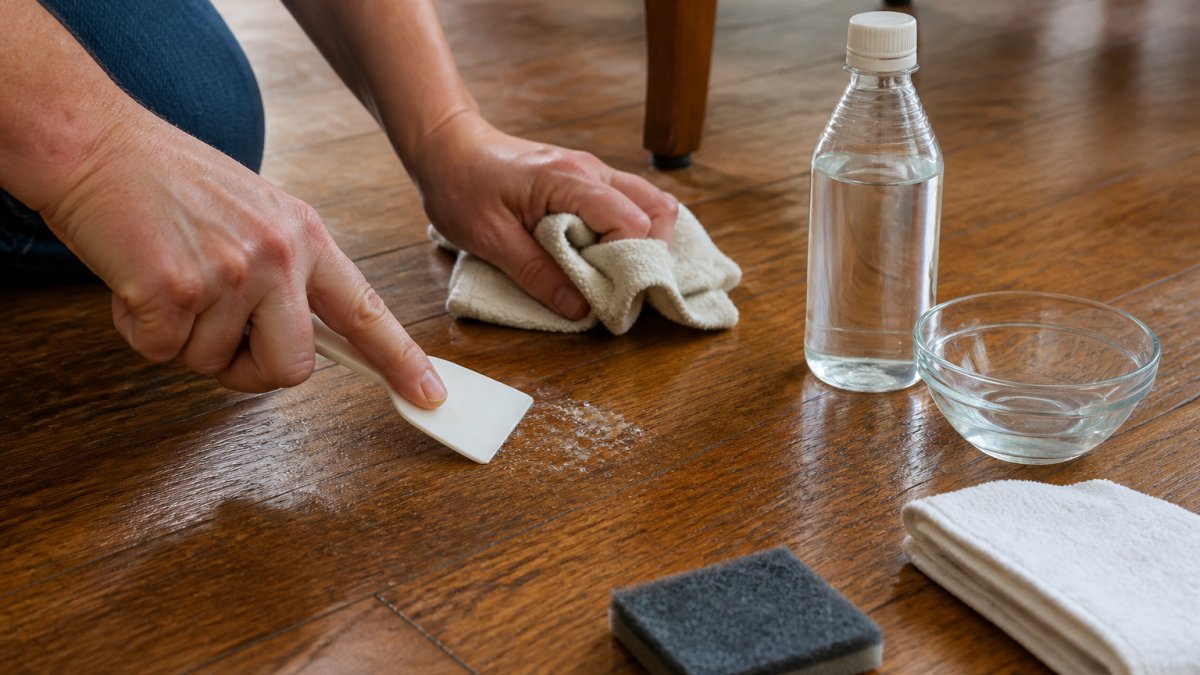
- Scrape off the loose felt with a plastic scraper or an old credit card. Never use a metal blade.
- Soften the glue with a warm, damp cloth held in place for a minute or two.
- Lift the residue with a cloth and a small amount of suitable cleaner.
- Wipe with clean water and dry the area fully.
Removing Adhesive from Hardwood and Timber
Timber and hardwood need the gentlest approach. Start with warmth and a plastic scraper before you reach for any liquid.
Try these in order:
- A warm damp cloth pressed on the spot for two minutes
- A plastic scraper at a shallow angle
- A cloth dampened with white vinegar for stubborn patches
- A dedicated adhesive remover only if the above fails
Always test any liquid on a hidden patch first. Wipe dry straight away, because standing moisture is the real enemy of timber.
Removing Adhesive from Vinyl, Tile, and Laminate
Vinyl, tile, and laminate handle more cleaning options than timber, but vinyl has a wear layer you don't want to strip.
Use this order:
- Warm soapy water and a cloth for fresh residue
- Isopropyl alcohol on a cloth for gummy patches
- A plastic scraper, never metal
- No acetone or harsh solvents on vinyl
Rinse with clean water afterwards. Soap film left behind attracts new dirt and makes the floor feel tacky.
Why Felt Pads Fall Off Chair Legs
Felt pads fall off chair legs because the adhesive can't cope with the sideways force of a chair being used. Glue holds best against pull. Chairs push, twist, and slide, which is the exact motion adhesive is worst at resisting.
Other common causes:
- Dust and oil on the leg before the pad went on
- A curved or splayed leg that only touches the pad at one edge
- Too small a pad for the weight of the furniture
- Cheap adhesive that dries out and cracks
The thing nobody tells you about felt pads is that the glue is doing all the work. There's no mechanical grip holding the pad in place. Once the glue weakens, nothing keeps the pad on.
10-13mm Compact Bonded THICK black Felt Sled Tip - VAR23BFCT our best seller →
Felt Pads vs Silicone Chair Leg Protectors
Silicone chair leg protectors hold on with a stretch fit rather than glue, so they don't leave residue. Felt pads rely on adhesive. That single difference decides which one suits your furniture.
| Feature | Felt Pads | Silicone Protectors |
|---|---|---|
| How it stays on | Adhesive | Stretch fit |
| Residue risk | High over time | None |
| Best for | Light, rarely moved furniture | Chairs moved daily |
| Noise reduction | Good | Good |
| Floor types | Smooth hard floors | Hard floors and carpet |
| Lifespan | Shorter on busy chairs | Longer under heavy use |
Felt glides still have a place. On a display cabinet that never moves, a felt pad is cheap and effective. On a dining chair used three times a day, glue is the wrong tool for the job.
Our felt-infused silicone caps combine both ideas.
How to Prevent Furniture Pads from Sliding Off
Preventing furniture pads from sliding off comes down to surface prep, correct sizing, and choosing a fixing method that suits how much the furniture moves. Get those three right and pads stay put.
Work through this checklist before fitting any pad:
- Wipe the chair leg clean and let it dry fully
- Check the leg shape: round, square, or splayed
- Measure the leg width in millimetres before ordering
- Match the pad size to the leg, not to the floor
- Press firmly for 30 seconds and don't move the chair for an hour
- Check pads monthly and replace any that have started to shift
For heavy-use furniture, skip adhesive entirely. A clip-on or stretch-fit protector won't slide because there's no glue to fail.
Choosing the Right Protector for Your Floor Type
Choosing the right protector starts with your floor, then your furniture, then how often it moves. A pad that suits tile may mark vinyl. A pad that suits timber may grip too hard on carpet.
Use this guide:
- Timber and hardwood: felt glides or felt-infused silicone caps give a smooth, quiet glide
- Vinyl and laminate: felt-faced protectors, checked often for grit
- Tile: felt or silicone both work well
- Carpet: silicone or cup-style protectors that won't catch in the pile
For sled-base chairs, our felt sled chair clips fit most tube sizes and use a high-quality wool blend felt. They clip on, so there's no adhesive to break down. Our 10-13mm compact bonded felt sled tip is our bestseller for commercial sled legs, with felt bonded to nylon for durability.


Both are built for the heavy use that destroys stick-on pads. If you're protecting new timber floors or managing a busy hospitality space, that difference matters.
Frequently Asked Questions
Why do felt pads leave sticky residue on floors?
Felt pads leave sticky residue because the pressure-sensitive adhesive backing breaks down over time. Heat, humidity, and the friction of chairs sliding across the floor cause the glue to soften and migrate through the felt onto the floor surface. Once the adhesive dries, it forms a gummy patch that attracts dust and dirt. Cheap pads with thin adhesive layers fail fastest, often within weeks in busy households.
Can vinegar remove felt-pad adhesive from a floor?
White vinegar can soften light adhesive residue on sealed timber and vinyl floors. Mix equal parts white vinegar and warm water, apply with a cloth, and leave for a few minutes before wiping. Do not use vinegar on unsealed timber or stone, as the acid can dull the surface. For stubborn patches, a plastic scraper works better than a metal one, which can gouge the floor.
Why do felt pads keep falling off chair legs?
Felt pads fall off chair legs when the adhesive cannot grip the leg surface. Dust, oil, and moisture prevent a strong bond, and legs with curved or splayed shapes give the flat pad little contact area. Movement across the floor also peels the edges up over time. Cleaning the leg with methylated spirits before applying a pad helps, but clip-on or silicone caps stay put far longer on awkward leg shapes.
Are silicone chair-leg protectors better than adhesive felt pads?
Silicone chair-leg protectors avoid the sticky residue problem entirely because they stretch over the leg rather than gluing to it. They stay in place on splayed and tapered legs, and the felt-infused versions combine quiet movement with floor protection. Adhesive felt pads cost less upfront but often need replacing within months. For timber floors and heavy daily use, silicone or clip-on felt glides are the more reliable choice.
Sticky residue is a glue problem, not a floor problem, and the fix is to remove glue from the equation. Chair Tips has spent over 20 years helping homes and businesses protect their floors with felt-infused silicone caps, commercial-grade durability, and specialised designs for different furniture leg shapes. Browse our range and choose options that suit your chairs, your floors, and how hard your furniture works.